

Planetary Navigation Calculations
Calculation of the Hour Angle and Declination — Example Using Venus
Determine the hour angle and declination at 01:20 UTC on January 1.


Step 1
Identify the value of the planetary parameter (EP) that immediately precedes the observation time in the Nautical Almanac.
(EP: A custom-defined planetary parameter Eₚ used in this publication.
It does not represent standard ephemeris values.)
Step 2
The parameter EP is tabulated at two-hour intervals.
To obtain the value at the desired time, apply the correction derived from the P.P. table in the right-hand column.
Since planetary motion varies more significantly than solar motion, this correction is essential.
Step 3
The hour angle is obtained by adding the observation time (UTC) to the corrected EP value.
Step 4
Since the resulting value is expressed in time units, convert it to angular units by multiplying by 15.
Step 5
For declination, determine the value closest to the observation time.
Apply the corresponding P.P. correction from the right-hand column.
If the correction is positive, add it to the base value; if negative, subtract accordingly.
Calculation of the Meridian Passage Time — Example Using Mars
Determine the meridian passage time on January 1 for longitude 140°E
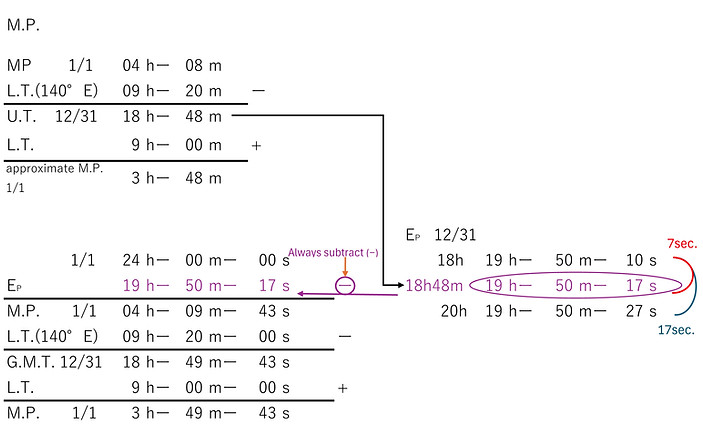


Step 1
From the meridian passage time (M.P.) given in the upper right of the planetary section of the Nautical Almanac, apply the longitude correction to obtain Universal Time (UT).
Subtract for east longitude and add for west longitude.
If the result exceeds 24 hours or falls below 0 hours, refer to the Nautical Almanac of the following or previous day, respectively.
At this stage, an approximate meridian passage time in standard time may also be obtained by applying the longitude corresponding to the standard meridian.
Add for east longitude and subtract for west longitude.
For a more accurate meridian passage time, proceed to Step 2.
Step 2
Since the meridian passage of a planet does not necessarily occur near 12:00 as in the case of the Sun, it is treated with reference to 24:00.
Step 3
EP values are given at 2-hour intervals.
To obtain the value at the desired time, apply the corresponding correction from the P.P. table (blue box in the right column).
This correction corresponds to an interpolation based on the time variation of the hour angle, and is particularly important for planets, whose motion varies more rapidly than that of the Sun.
Step 4
Using the corrected EP obtained in Step 3, determine the meridian passage time (LMT) with reference to 24:00.
That is, by subtracting the corrected EP from 24 hours, a more accurate meridian passage time (LMT) is obtained.
Next, apply the longitude correction to convert this value to Universal Time (UT).
Subtract for east longitude and add for west longitude.
Finally, to convert to a desired standard time, apply the longitude corresponding to the standard meridian.
Add for east longitude and subtract for west longitude.
Correction of the Observed Altitude — Example Using Venus

.jpg)
